
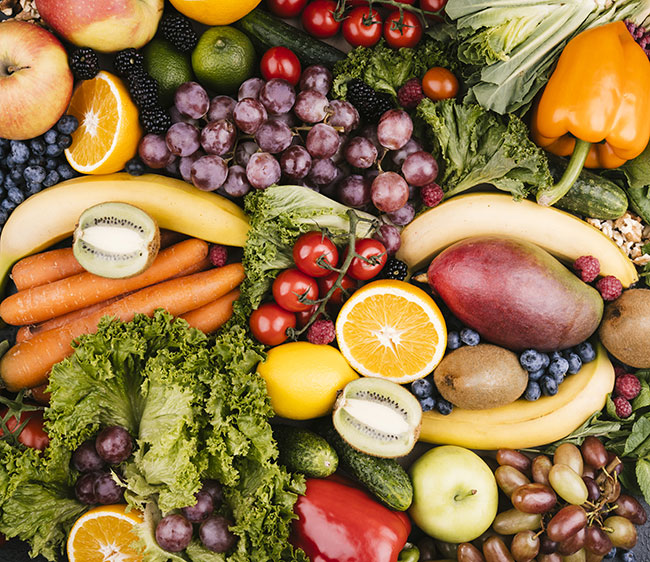
Perhaps you hear people talking about the seasonality of fruits and vegetables around you? Unless you yourself are already in this process. But what exactly does it mean to eat in season and what benefits could one derive from it?
Well, first of all, it simply means eating fruits and vegetables that have grown as naturally as possible, that are grown locally and that are available according to their harvest season.
Therefore, exit pesticides, greenhouses, imported products, … which make us believe that these products are available all year round and in abundance.
Yes, because these off-season products have a cost: a financial cost, because they are often very expensive; a cost for the environment, because their production pollutes enormously, … In addition, consumers are not mistaken when they see the quality of these products, both in terms of taste and nutritional values.
But unfortunately, there are still people who are not very attentive to the importance of paying attention to the seasonality of the fruits and vegetables they consume on a daily basis.
And that, I understood it well, because I prepared an article for you to better convince you or even that you can speak about it to your close relations or your entourage.
So, let’s see, right away, the benefits of eating seasonal fruits and vegetables.
THE BENEFITS OF EATING SEASONAL FRUITS AND VEGETABLES
So here we’ll see why it’s so important to focus on seasonal fruits and vegetables. That it’s not just a fad or a fad. No really not …
What is the point of eating in season? Because they have more taste
Fruits and vegetables that have reached maturity in the sun, or that have had time to develop in the wild, have more flavor.
This is not the case for those which have been picked green and which have matured, either during transport (plane, boat, truck, …), or at the place of storage. Ditto for those who have been grown above ground.
So, for example, products that come from a more or less distant country are often harvested before maturity so that they can withstand the journey to reach us.
To this, it should be noted that seasonal fruits and vegetables are often local products. And ideally, they can come from short circuits (that is, there was only one intermediary between the producer and the consumer).
Therefore, tomatoes that taste like water, or strawberries that don’t taste or smell, surely don’t come next door. Or, they were probably grown in greenhouses or even above ground.
They contain more nutrients, more vitamins and minerals
Ripening gently in the sun gives them better nutritional quality, compared to those that were picked green or too early.
In addition, the fact that they are still fresh, but also readily available, allows buyers to benefit even more from their vitamins.
Seasonal fruits and vegetables are richer in antioxidants
Antioxidants protect our cells from free radicals. They are effective in lowering our cholesterol level, reducing the risk of cardiovascular disease, preventing cancer, protecting the eyes, combating the effects of pollution and delaying aging, etc.
And icing on the cake, they can even help us tan, lose weight and boost our immune system,…
And you know what ? Fruits and vegetables abound! 😉 But how can it be?
Well, the sun and external aggressions will “stress” fruits and vegetables, which will defend themselves, by producing a lot of antioxidants.
And this is where it gets interesting, because if you pick them too early, or if you grow them in a greenhouse, or if you “help” them with pesticides, they will produce less.
It is even, moreover, for this reason also that we are advised to favor organic.
They meet our nutritional needs of the moment
Eh yes ! Nature is good, because it gives us all the nutrients our body needs AND when it needs it. And that is very important, because it allows us to respect our natural cycle and further strengthen our immune system.
To illustrate this, in Winter we spend a lot of calories to warm up. In addition, we need a lot of nutrients and vitamins. This for the simple and good reason that we must defend ourselves against diseases of the cold season (ENT infections, …), but also … against the lack of light.
This is good, because it is the season of cabbage, potatoes, carrots, … which are very satisfying in addition to containing a lot of nutrients. And it is also the season of citrus fruits, like oranges, mandarins, … which are full of vitamins C.
Then in summer, because of the heat, we don’t need to spend a lot of energy, but we need to hydrate ourselves.
This is why, in this period, nature has provided fruits and vegetables low in calories, but rich in water such as: tomatoes, cucumbers, strawberries, melons, …
So thank you, who? Thank you mother nature! 😉
They are “eco-friendly” (more environmentally friendly)
Fruits and vegetables out of season either mean that they come from far away, or that they were grown locally, but … in a greenhouse!
Well, it makes me think that even products that come from abroad, can also have been grown under glass. What do you want ! Everything is good to make great returns and always earn more money. 🙁
And to return to our sheep, in both cases, it is harmful to the environment.
Thus, in the first case, the fruits and vegetables come from a foreign country, such as Spain, Morocco, Brazil, … And this poses the problem of carbon footprint of these products, because it will have been necessary to burn tons fuels to transport them. As a result, this HUGE increases pollution and greenhouse gas emissions.
Not to mention all the means that had to be put in place for optimal product transport. Like refrigeration, air conditioning, the use of products preventing fruits and vegetables from ripening during transport, overpacking (excessive packaging which produces a lot of waste), … And what do I know! 🙁
So, for example, before reaching your plate, your tomato will have had time to go around the world. Another example, 1 kg of strawberries on your stalls in winter may have required up to 5 L of diesel oil !! It’s a crazy thing !!